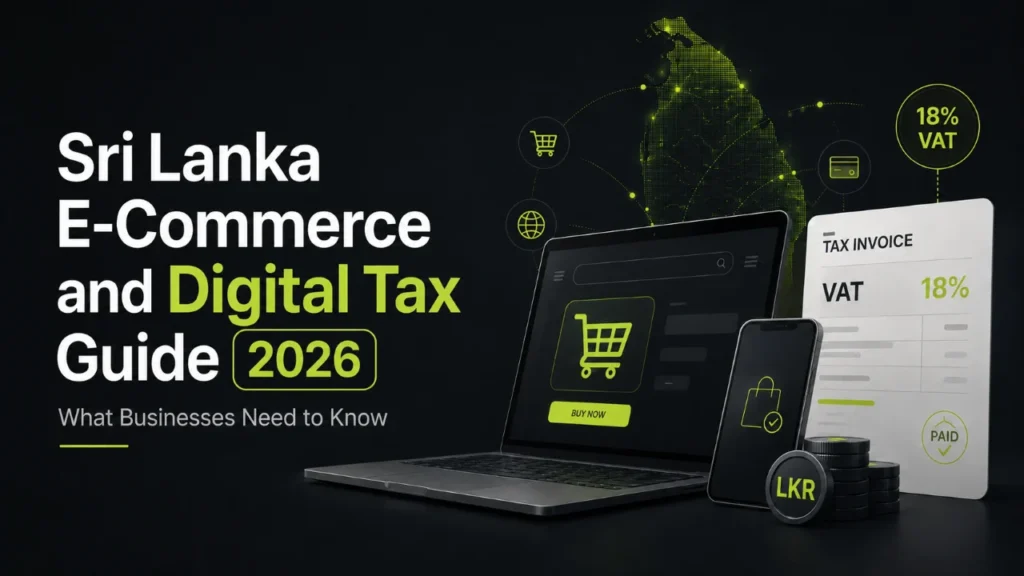
If you run an online business, an agency, or an e-commerce store in Sri Lanka today, you might feel like you are living in Europe. You earn globally, you use international tools, and you operate completely digitally. But with this modern business lifestyle comes a very modern reality: the era of running a business like it’s your personal pocket money is over. Let us understand Sri Lanka E-Commerce and Digital Tax Guide 2026
For years, many Sri Lankan entrepreneurs have operated in a gray area. You have a business, but you use your personal bank account. You withdraw money whenever you want, without documenting it. You pay for software, ads, and inventory, but you never keep the receipts.
Here is the hard truth for 2026: In Sri Lanka, that is now a serious financial risk.
The “Data Trail” Reality Check of Sri Lanka E-Commerce and Digital Tax Guide 2026
Many people still ask the wrong question: “How will the government ever know how much I make?” The Inland Revenue Department (IRD) does not need to manually check every single person. The modern financial system operates on Data Trails. Every time a customer pays you through a payment gateway, every time you run Facebook ads, every courier record you generate, every vehicle you lease, and every time you import or export goods—a data trail is left behind.
If your officially declared income is small, but your bank deposits are massive, one day you may be asked to explain your source of funds. If you do not have the records to back it up, you are going to be trapped.
The Tale of Two Entrepreneurs: Saman vs. Mike
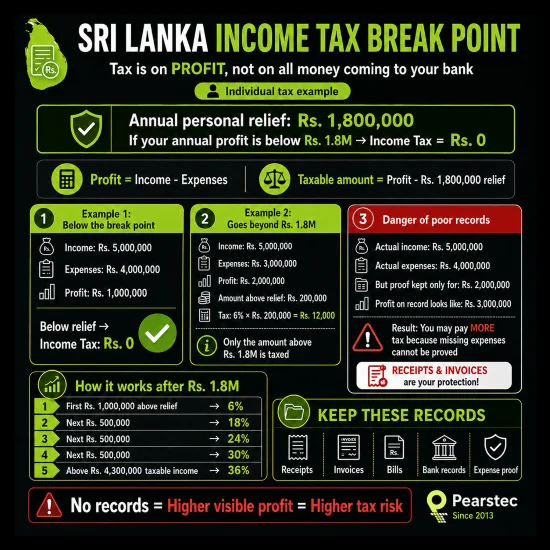
The biggest misconception about income tax is that it is charged on your total revenue (the money that comes into your bank). It is not. Tax is charged on your profit. Currently, in Sri Lanka, the tax-free limit for an individual is Rs. 1.8 million per year (Rs. 100,000 a month). After that, the first Rs. 500,000 of taxable income is charged at a 6% rate.
Let’s look at a story of two business owners to see how this actually works.
According to the Inland Revenue Department tax chart for 2025/2026, individuals are entitled to personal relief of Rs. 1,800,000 per year.
The Case of Saman (The Organized Owner) Saman runs a successful e-commerce store. He makes Rs. 5 million in revenue a year. He spends Rs. 4 million on Facebook ads, inventory, packaging, and software. Saman runs a proper business—he uses a separate bank account, keeps every receipt, and issues invoices. When tax season arrives, Saman can prove his Rs. 4 million in expenses. His official profit is Rs. 1 million. Because this is below the Rs. 1.8 million relief limit, Saman pays zero income tax.
The Case of Mike (The “Pocket Money” Owner) Mike runs the exact same type of business. He also makes Rs. 5 million in revenue and also spends Rs. 4 million on ads and inventory. However, Mike uses his personal account. He pays for his Canva and Veo 3 subscriptions with his credit card but never downloads the invoices. He mixes his personal house rent with his business workspace rent. When tax season arrives, Mike tries to claim his Rs. 4 million in expenses. But without receipts, invoices, or proper accounts, the IRD only accepts Rs. 2 million of his expenses as valid. On paper, Mike’s profit is now calculated as Rs. 3 million. Because of his poor record-keeping, Mike’s profit is pushed far above the Rs. 1.8 million limit. He is now forced to pay income tax starting at the 6% bracket, scaling upwards. Mike pays a heavy tax not because he earned more, but because he lost his proof of expenses.
The best thing to do to play a fair game is to maintain an Accounting System in-house for your peace of mind, ensuring every rupee you spend is legally accounted for.
Pearstec Accounting Solutions
The Hidden Traps of Digital Business
Mike’s story happens every day in Sri Lanka. Here are two of the most common ways digital entrepreneurs lose their money to avoidable taxes:
- The Subscription Trap: You pay for online tools, servers, or software, but fail to download the monthly PDF invoices. Without that piece of paper or digital file, it is not a recognized business expense. Your taxable profit goes up.
- The Rent Trap: You work from home and pay rent partly from a personal account and partly from your business account. If part of your home is a dedicated workspace, you must clearly document that portion with proper agreements. Mixing the two without records means those payments cannot be easily justified during a review.
Build Clean, Scale Fast
Organizing your finances is not about living in fear of the government. It is about building a strong, real company.
When your business becomes formal, banks will trust you with loans to expand. Investors will trust you with capital. Customers will trust you with larger orders. A clean business is not a weak business; a clean business is a business that can scale.
If your business is visible enough to attract customers, it is visible enough to leave a trail. Do not wait for questions to be asked.
- Talk to someone who can build an accounting system to you
- Open a separate business bank account today.
- Keep every digital and physical bill.
- Record your daily payments and sales.
- Use proper accounting software.
- Speak to a tax professional before you cross major turnover milestones.
Stop hiding, start organizing, and build your business the right way.
Some Frequently Asked Questions
FAQ 1 – Do I have to pay income tax on all the money deposited in my business bank account?
No. In Sri Lanka, you are not taxed on your total bank deposits. You are only taxed on your net profit. This is why it is essential to keep all your receipts and invoices so you can legally prove your business expenses and lower your taxable profit.
FAQ 2 – What is the personal income tax free limit in Sri Lanka for 2026?
The personal relief tax-free threshold is LKR 1,800,000 per year, which breaks down to LKR 150,000 per month. If your annual profit is below this amount, you do not have to pay personal income tax.
FAQ 3 – Can I claim large cash payments as a business expense to reduce my tax?
No. If you make a payment of LKR 500,000 or more in a single day for a transaction using cash, it will not qualify for a tax deduction. To legally claim large business expenses, you must use traceable methods like a credit card, bank draft, electronic payment, or an “Account Payee” cheque.
FAQ 4 -Why do I need a TIN to run a business in Sri Lanka?
A Taxpayer Identification Number (TIN) is now legally mandatory for critical business operations. You must have a TIN to open a business bank account, register a new business, transfer company shares, or register vehicles and property.